

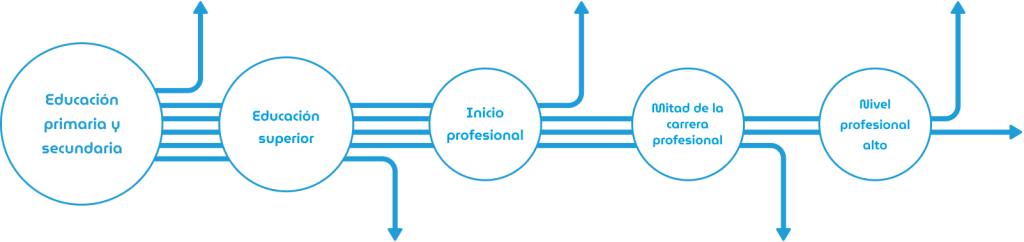
En esta “tubería del progreso profesional” de las mujeres representamos el camino que recorren muchas niñas y jóvenes, desde la educación primaria y secundaria hasta su incorporación al mundo profesional.
A lo largo de este recorrido aparecen barreras visibles e invisibles que influyen en sus decisiones, oportunidades y permanencia en las carreras STEAM.
Estereotipos
Prejuicios
Falta de referentes
Falta de conocimiento sobre carreras STEM
Desinterés por carreras STEM
Expectativas culturales/familiares
Estereotipos
Prejuicios
Discriminación
Acoso
Falta de referentes
Técnicas de contratación erróneas
Responsabilidades familiares
Discriminación
Acoso
Falta de referentes
Falta de mentores
Falta de seguridad laboral
Falta de flexibilidad laboral
Estereotipos
Menor acceso a oportunidades de desarrollo
Dificultad en refuerzo/reingreso al trabajo
Falta de flexibilidad laboral
Meritocracia defectuosa para el avance profesional
Falta de mentores/promotores
Interrupciones en la profesión
¿Por qué muchas niñas y jóvenes se van quedando por el camino en las disciplinas STEAM?
Identificamos algunos de los factores y barreras que contribuyen a este fenómeno. También proponemos acciones y buenas prácticas que pueden ayudar a que más niñas continúen desarrollando su talento en ciencia, tecnología, ingeniería, arte y matemáticas.
Mientras que los niños suelen ser alentados a tomar riesgos y perseverar, las niñas suelen recibir mensajes que enfatizan la perfección y el miedo al error, lo que refuerza su autolimitación. Este efecto se amplifica en la adolescencia, cuando la presión social y los estereotipos de género se vuelven más marcados, empujándolas a evitar campos donde no se sienten plenamente competentes.
Three influential lines of research support and nuance the statement you propose, especially around (1) gendered confidence, (2) perfectionism and fear of failure, and (3) adolescence as an amplification point for stereotypes and social pressure.
A precise single “top” article is harder to name because this is a broader empirical stream, but a strong representative is:
Fomentar entornos educativos y sociales donde el error se vea como parte natural del aprendizaje y se anime a las niñas a asumir riesgos y explorar su potencial.
Desde edades tempranas, las niñas se enfrentan a una notable ausencia de modelos a seguir que reflejen su potencial en carreras científicas y tecnológicas. Los libros de texto, los medios de comunicación y las actividades escolares suelen destacar figuras masculinas, perpetuando la percepción de que las STEM son “terreno de hombres”. Además, sin mentoras o figuras cercanas que hayan recorrido ese camino, resulta difícil para las jóvenes imaginarse a sí mismas en roles científicos o tecnológicos. La falta de referentes no solo limita su aspiración, sino que también reduce el apoyo social y la validación necesaria para persistir en un entorno que, a menudo, es percibido como poco acogedor para ellas.
Large-scale content analyses show that textbooks underrepresent women and depict men far more often in scientific and technological roles, sending the message that STEM is “for men.” These “hidden lessons” make it harder for girls to see their own potential in these fields and contribute to lower identification with STEM and narrower aspirations.
Studies on mathematics education and STEM curricula emphasize that real female scientists, engineers and technologists are largely absent from examples, biographies and classroom activities. Even when fictional male and female characters are balanced, the lack of real women who “have walked that path” makes it difficult for girls to imagine themselves in such roles.uoc
Example reference
Interview and analysis summarizing research: De la Torre, A. M. (2024). There is a shortage of female role models in mathematics. Universitat Oberta de Catalunya – UOC News.uoc
International reports explicitly identify lack of female role models and mentors as a central barrier for girls in STEM, limiting aspirations and weakening the social support needed to persist in male-dominated environments. These documents link the scarcity of women in STEM teaching posts, media coverage and leadership to girls’ difficulties in seeing STEM as a welcoming option.education.europa+2
Example references
Promover la visibilidad de mujeres en STEM, tanto históricas como contemporáneas, y fomentar espacios donde niñas y jóvenes puedan interactuar con estas referentes, es clave para cerrar esta brecha.
El imaginario social construido a través de medios como la televisión, las series, las películas, los juegos, libros, etc.. tiene un impacto profundo en las aspiraciones y elecciones de las niñas y jóvenes, actuando como un poderoso «filtro» que afecta su interés por las carreras STEM. Durante décadas, estos medios han representado a científicos, ingenieros, programadores y matemáticos como hombres brillantes, excéntricos o antisociales, mientras que las mujeres en estos roles han sido invisibilizadas o retratadas en papeles secundarios y estereotipados.
Además, los productos culturales dirigidos a las niñas, como juguetes, libros y series infantiles, a menudo priorizan narrativas relacionadas con la apariencia, las emociones o las relaciones personales, dejando de lado historias que promuevan la curiosidad científica, el pensamiento lógico o la resolución de problemas. Incluso en videojuegos, un sector con gran influencia en la formación de intereses tecnológicos, los personajes femeninos suelen estar relegados a roles decorativos o secundarios, lo que dificulta que las niñas se identifiquen con estas áreas.
Three influential lines of research support and nuance the statement you propose, especially around (1) gendered confidence, (2) perfectionism and fear of failure, and (3) adolescence as an amplification point for stereotypes and social pressure.
Reference
Steinke, J. (2017). Adolescent girls’ STEM identity formation and media images of STEM professionals: Considering the influence of contextual cues. Frontiers in Psychology, 8, 716.
Reference
Geena Davis Institute on Gender in Media (2018, updated 2024). Portray Her: Representations of Women STEM Characters in Media. Geena Davis Institute on Gender in Media.geenadavisinstitute
Example references
Juricevic, I. (2022). STEM stereotypes and Marvel superpowers. REDEN – Revista de Educación y Derecho, 26, 1–25. (analysis of gender representation in portrayals of STEM-like skills in popular comics/hero narratives).erevistas.publicaciones.uah
Promover la creación de contenidos que muestren a mujeres en roles protagónicos en STEM, con historias que destaquen sus logros y desafíos de manera atractiva e inspiradora, rompiendo además con el estereotipo de seres antisociales.
Desde temprana edad, estas expectativas moldean lo que se considera «apropiado» para ellas, reforzando roles de género tradicionales que asocian a las mujeres con cualidades como la empatía, el cuidado y la comunicación, mientras que atribuyen habilidades analíticas, técnicas y de liderazgo a los hombres. Estas creencias limitan el espectro de opciones que las niñas perciben como posibles o deseables para su futuro.
En el entorno familiar, las niñas pueden recibir mensajes sutiles o explícitos que las alejan de las STEM, como comentarios sobre la dificultad de las matemáticas o la ingeniería, o la percepción de que estas áreas son menos compatibles con su personalidad o estilo de vida. En el ámbito educativo, docentes también desempeñan un papel clave, ya que a menudo, de forma inconsciente, tienden a fomentar que los niños persigan carreras tecnológicas mientras animan a las niñas hacia áreas relacionadas con las humanidades o las ciencias sociales.
A nivel social, las niñas enfrentan una presión constante para encajar en normas culturales que valoran más su apariencia o habilidades sociales que su potencial intelectual o técnico. Esto se intensifica durante la adolescencia, cuando el deseo de aceptación social puede llevarlas a evitar destacar en campos percibidos como “masculinos”.
Three influential lines of research directly support this statement about how family, teacher and social expectations channel girls away from STEM.
Key reference
Casad, B. J., Hale, P., & Wachs, F. L. (2015). Parent–child math anxiety and math‑gender stereotypes predict adolescents’ math education outcomes. Frontiers in Psychology, 6, 1597.pmc.ncbi.nlm.nih
This supports: parental comments about math being “too hard” for girls, or not fitting their personality or lifestyle, reduce girls’ perceived options and steer them away from STEM, even when achievement is similar.
Representative references
This supports: teachers unconsciously encouraging boys more toward technological careers and girls toward humanities/social fields, reinforcing the idea of what is “appropriate” for each gender.
Key references
These support:
A menudo, las carreras STEM son desconocidas o explicadas de manera abstracta, técnica y desvinculada de las realidades cotidianas, lo que dificulta que las niñas se identifiquen con ellas, en lugar de enfocarlas como herramientas para resolver problemas sociales, mejorar la vida de las personas o generar un impacto positivo en el mundo.
Three highly cited research programs support this statement about STEM career perceptions:
Reference
Wang, M.-T., Eccles, J. S., & Kenny, S. (2016). Not lack of ability but more choice: Individual and gender differences in choice of careers in math-intensive fields. Perspectives on Psychological Science, 11(1), 20–46.pmc.ncbi.nlm.nih
Key reference
Diekman, A. B., Brown, E. R., Johnston, A. M., Kray, L. J., & Steinberg, M. (2010). Seeking congruity between goals and roles: A new look at why women opt out of science, technology, engineering, and mathematics careers. Psychological Science, 21(8), 1051–1057.wellesley
Diekman, A. B., & Steinberg, M. (2017). A goal congruity model of role entry, engagement, and exit: Understanding gendered patterns and predictors of STEM phenomena. Personality and Social Psychology Review, 22(2), 142–175.journals.sagepub
Reference
Cyr, E. N., et al. (2025). Girls’ forecasted fit in STEM fosters career interest. Child Development.yorku
These three works—Wang for empirical patterns, Diekman for the theoretical model, and Cyr for intervention evidence—provide a strong foundation to argue that abstract presentations of STEM careers obscure their relevance to girls’ values, limiting identification and choice.journals.sagepub+3
Esta ansiedad, que se manifiesta como un miedo o incomodidad intensa al enfrentarse a tareas matemáticas, suele desarrollarse desde edades tempranas y está estrechamente ligada a estereotipos de género que asocian las matemáticas con habilidades inherentemente masculinas. Muchas niñas internalizan estos mensajes, lo que puede llevarlas a dudar de sus propias capacidades casi como una profecía autocumplida, incluso cuando su desempeño es igual o superior al de sus compañeros.
Three highly cited research programs strongly support this statement about math anxiety as a gendered phenomenon linked to stereotypes:
Reference
Casad, B. J., Hale, P., & Wachs, F. L. (2015). Parent-child math anxiety and math-gender stereotypes predict adolescents’ math education outcomes. Frontiers in Psychology, 6, 1597.pmc.ncbi.nlm.nih
Reference
Bieg, M., Goetz, T., & Lipnevich, A. A. (2015). Gender stereotype endorsement differentially predicts girls’ trait-state discrepancy in math anxiety. Frontiers in Psychology, 6, 1404.frontiersin
Reference
Rossi, S., Hallgato, A., & Tomasetto, C. (2022). Mathematics–gender stereotype endorsement influences mathematics anxiety, self-concept, and performance differently in men and women. Developmental Science, 25(6), e13280.pmc.ncbi.nlm.nih
These three studies—Casad for intergenerational transmission, Bieg for trait-state discrepancies, and Rossi for causal mediation—provide robust evidence that math anxiety is tightly linked to stereotypes associating math with masculine skills, leading girls to doubt their abilities and avoid math despite equal or superior performance.pmc.ncbi.nlm.nih+2
Aquellas personas que se encargan de la orientación académica, docentes e incluso familias tienden a guiar a las niñas hacia carreras consideradas «más femeninas» o alineadas con habilidades percibidas como innatas, como la comunicación o el cuidado, en lugar de promover áreas como ingeniería, informática o matemáticas. Este sesgo, muchas veces sutil, refuerza la idea de que las STEM no son una opción natural para las niñas, influyendo en sus elecciones académicas y limitando sus aspiraciones. Además, los mensajes recibidos durante la orientación suelen enfatizar habilidades “blandas” (soft skills), como la empatía y el trabajo en equipo, mientras se resta importancia a sus capacidades técnicas o científicas. Esto no solo perpetúa estereotipos de género, sino que también reduce las posibilidades de que las niñas exploren o consideren seriamente carreras STEM.
Three key research programs provide strong evidence for this statement on biased academic guidance steering girls away from STEM:
Teachers often unconsciously attribute higher mathematical ability to boys than equally performing girls and provide less encouragement for girls to pursue advanced STEM courses or technical careers.pmc.ncbi.nlm.nih+1
This manifests as guidance counselors and educators directing high-achieving girls toward «safe» humanities or caregiving fields while pushing boys toward engineering and computer science.scholarcommons.sc+1
Key reference
Ganley, C. M., & Lubienski, S. T. (2016). Mathematics confidence, interest, and performance: Examining gender patterns and profiles. Journal for Research in Mathematics Education. (Also summarized in University of Illinois analysis of early gender gaps).education.illinois
Kirkland, H. N. (2023). STEM Educators’ Perceptions of Gender Bias and the Underrepresentation of Female Students. University of South Carolina dissertation.scholarcommons.sc
Parents and academic advisors hold gendered beliefs about occupational suitability, with girls receiving messages that STEM fields conflict with family responsibilities or feminine personality traits.unr+1
Counselors emphasize girls’ «soft skills» like communication and empathy while overlooking their analytical potential, limiting the career options presented as realistic.aauw+1
Key references
AAUW (2025 update). The STEM Gap: Women and Girls in Science, Technology, Engineering and Mathematics. American Association of University Women.aauw
Cech, E., & Blair-Loy, M. (2019). The changing career trajectories of new parents in STEM. (Contextualized in workplace bias literature).unr
From secondary school through university advising, systemic biases result in fewer girls being recommended for STEM programs, with guidance materials and career talks reinforcing STEM as masculine.sciencepolicyreview+1
This «subtle steering» reduces girls’ exploration of technical fields and perpetuates underrepresentation, as evidenced by educators’ own perceptions of gendered career appropriateness.scholarcommons.sc
Key reference
Llorens, A., et al. (2021). Gender bias in academia: a lifetime problem that needs solutions. Neuron, 109(13), 2047–2074.pmc.ncbi.nlm.nih
Science Policy Review (2020). Reducing gender bias in STEM.sciencepolicyreview
En muchas disciplinas STEM, existe la percepción de que el éxito depende de una capacidad innata o «brillantez», en lugar de esfuerzo y dedicación. Este mito de la brillantez suele estar sesgado por género, ya que se asocia con mayor frecuencia a los hombres, mientras que a las mujeres se les atribuyen logros basados en su dedicación o perseverancia. Mientras que los niños son más propensos a recibir mensajes que refuerzan sus habilidades intrínsecas, las niñas suelen ser alabadas por su esfuerzo, lo que puede disminuir su confianza en sus capacidades.
Three highly cited research programs directly support this statement about the «brilliance myth» in STEM and its gendered consequences:
Fields perceived as requiring «raw intellectual talent» or «brilliance» rather than effort have fewer women; this belief correlates strongly with female underrepresentation across 67 academic disciplines.science
Brilliance is culturally associated with men more than women, creating a stereotype that disadvantages women in STEM fields like physics and math where innate genius is emphasized.pmc.ncbi.nlm.nih+1
Reference
Leslie, S.-J., Cimpian, A., Meyer, Z., & Freeland, E. (2015). Expectations of brilliance underlie gender distributions across academic disciplines. Science, 347(6219), 262–265.pmc.ncbi.nlm.nih
By age 6, girls are less likely than boys to associate their gender with «brilliance,» leading them to avoid activities described as requiring exceptional talent; this shapes long-term STEM interest.science
Girls receive praise focused on effort rather than ability, reinforcing doubt about their intrinsic talent compared to boys who are affirmed as «naturally brilliant.»stemwomen+1
Reference
Bian, L., Leslie, S.-J., & Cimpian, A. (2017). Gender stereotypes about intellectual ability emerge early and influence children’s interests. Science, 355(6323), 389–391.science
Even women already studying STEM endorse stronger «brilliance» beliefs than men and experience higher belonging uncertainty, showing how these stereotypes persist and erode women’s confidence.pmc.ncbi.nlm.nih
Women attribute success to effort while men claim innate talent, perpetuating the cycle where girls doubt their «fit» for brilliance-heavy fields.pmc.ncbi.nlm.nih
Reference
Deiglmayr, A., Stern, E., & Schubert, R. (2019). Beliefs in «brilliance» and belonging uncertainty in male and female STEM students. Frontiers in Psychology, 10, 1252.pmc.ncbi.nlm.nih
Para mitigar este problema, es crucial desmantelar la narrativa de la brillantez como requisito exclusivo para el éxito en STEM así como la narrativa de que las chicas son trabajadoras pero no brillantes si obtienen buenas calificaciones.
Estereotipos
Prejuicios
Falta de referentes
Falta de conocimiento sobre carreras STEM
Desinterés por carreras STEM
Expectativas culturales/familiares
Estereotipos
Prejuicios
Discriminación
Acoso
Falta de referentes
Técnicas de contratación erróneas
Responsabilidades familiares
Discriminación
Acoso
Falta de referentes
Falta de mentores
Falta de seguridad laboral
Falta de flexibilidad laboral
Estereotipos
Menor acceso a oportunidades de desarrollo
Dificultad en refuerzo/reingreso al trabajo
Falta de flexibilidad laboral
Meritocracia defectuosa para el avance profesional
Falta de mentores/promotores
Interrupciones en la profesión
Mayor presión de formar parte de juntas y comités para cumplir con los requisitos de diversidad
Prejuicios
Responsabilidades familiares
Discriminación/sexismo